
What Medicaid’s Progress on Lactation Care Means for Health Plans
Georgia expanded telehealth lactation coverage. Now it’s time for commercial and additional state Medicaid plans to follow. Q&A with Amanda Minimi, VP of Health Solution Marketing & Operations Nationwide, policymakers are making meaningful progress in expanding access to lactation services. In Georgia, the state Medicaid plan recently expanded telehealth lactation services. Aeroflow Health’s team supported…
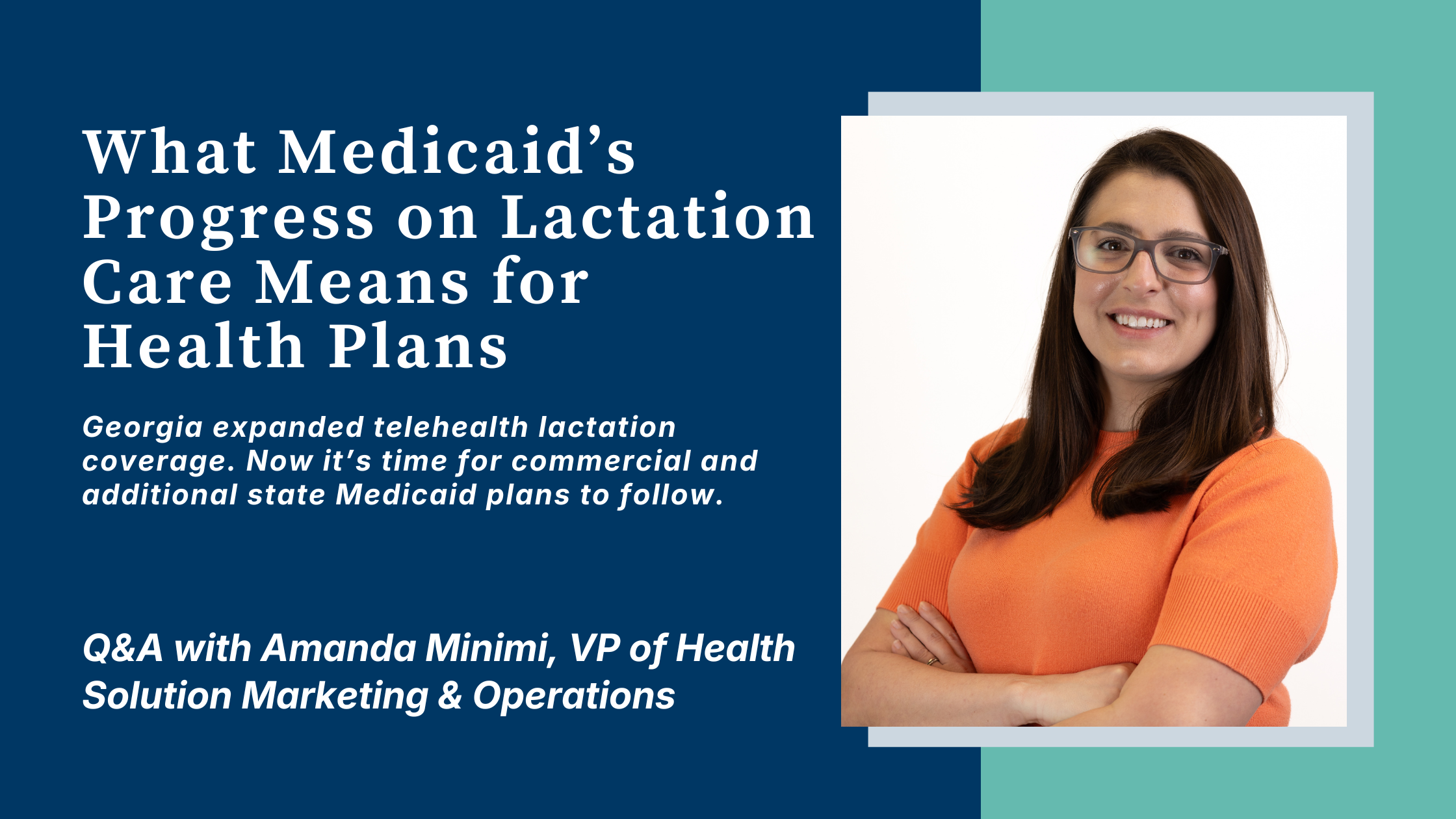
Georgia expanded telehealth lactation coverage. Now it’s time for commercial and additional state Medicaid plans to follow.
Q&A with Amanda Minimi, VP of Health Solution Marketing & Operations
Nationwide, policymakers are making meaningful progress in expanding access to lactation services. In Georgia, the state Medicaid plan recently expanded telehealth lactation services. Aeroflow Health’s team supported the advancement of the new policy, which expands on previous coverage that had required in-person visits, enabling mothers in Georgia to access prenatal and postpartum care resources from the comfort of their homes.
For more than a decade, Aeroflow Health has been a leading vocal advocate for patients, helping to break down the barriers that block access to reliable care. The Aeroflow team has advocated for policies that make healthcare more affordable and more easily accessible for families nationwide. Those efforts have been centered around the critical supplies and support that expecting and new mothers require in order to thrive. Breastpumps, lactation services, pumping supplies, nutrition guidance, and more are all essential for new mothers as they transition to postpartum.
We sat down with Aeroflow’s Amanda Minimi, VP of Health Solution Marketing & Operations to talk about the impact of Georgia Medicaid’s expanded coverage of telehealth lactation services and learn more about the barriers that still exist with commercial insurance and other state Medicaid plans.
Georgia Medicaid recently expanded coverage for telehealth lactation services. What changed, and why is this such an important milestone?
Amanda: This is an incredibly important milestone when you consider that not every Medicaid plan covers lactation services. In fact, not every plan covers breast pumps as preventative benefits overall. While the Affordable Care Act requires many private health plans to cover breastfeeding supplies, support and services at no cost as preventative benefits, Medicaid coverage is much less consistent. Unless a state has expanded Medicaid, you don’t often see breast pumps, lactation support, or telehealth services covered.
Our team at Aeroflow is excited to build on the existing breastpump coverage to offer lactation services virtually. Too often, one of the challenges with lactation services is that there aren’t enough lactation providers in each community. That results in mom having to pack up her car with all the baby items, find child care for other children or bringing them along, and balance scheduling the appointment with work. It’s a lot of pressure to put on a new mom who is already tired and stressed. Now, mom will be able to get that support from the comfort and convenience of her home.
Access to early lactation education in the prenatal period is so important. Traditionally, moms receive the most breastfeeding support during the “golden hour”, or the hour following birth. It’s during this time that a mom is surrounded by experts coaching her on how to breastfeed. When mom gets discharged, that’s when the most support is needed and yet it’s not easily accessible.
When mom starts breastfeeding education before she gives birth, it becomes a proactive approach to set her up for success. Understanding how your pump works, how the baby will latch, how often to nurse, and having this input in the prenatal phase is crucial for long-term success. Telehealth classes allow us to give her that support before and after the baby arrives.
What barriers have historically made it difficult for moms to access lactation support?
Amanda: Traveling to receive lactation care brings a variety of challenges for busy families. Scheduling around work and family life, transportation, and solidifying childcare are the most common barriers.
Policy and financial issues pile on top of these challenges. The average cost of a lactation visit can be upwards of $300 when lactation providers are not in network. Families get stuck paying out of pocket upfront, in hopes of being reimbursed. For many, the travel logistics aren’t sustainable and the costs become a detriment to care.
Other barriers are much more nuanced and hidden. Some health plans include lactation services in their networks, yet mothers still encounter barriers when trying to access them. This is one example of the access barriers some mothers with commercial insurance coverage in Georgia still face.
For example, mothers covered by Anthem Blue Cross and Blue Shield’s Elevance Health plan must go through their pediatrician or OB/GYN to connect with a lactation provider. That’s a less intuitive way to access support that can make the difference in how successful moms are in their breastfeeding journey. When offices don’t have a lactation provider on staff, moms have to ask to be connected to one. When new mothers are already overwhelmed, stressed or feeling ashamed, it can lead to fewer conversations about where and how to find a provider.
Why is lactation support so important for maternal and infant health outcomes?
Amanda: The benefits of breastfeeding are well documented. The CDC has connected breastfeeding to a reduced risk of asthma, obesity, type 1 diabetes, and sudden infant death syndrome (SIDS) in infants.
For mothers, breastfeeding can reduce the risk of high blood pressure, type 2 diabetes, as well as ovarian and breast cancer. What’s more is the mental health connection to breastfeeding. Recent studies have shown a correlation between lactation and reduced stress responses.
Expecting moms are informed on these benefits, and the pressure to be successful in breastfeeding begins to mount. Yet, there isn’t enough support to set them up for success.
Without prenatal education, many mothers enter breastfeeding having seen it idealized but never truly explained. When challenges arise, they are often left sorting through misinformation late at night, feeling isolated and unsure whether they are doing something wrong.
Medicaid has addressed some of these barriers. Where do gaps still exist today?
Amanda: Many gaps exist and one of the most prominent gaps is timing to deliver care to moms. Consider the state of Texas, where moms on state Medicaid can’t acquire a breast pump until the baby arrives. What that translates to in reality, is that moms are underprepared for how to use their pump at the same time they’re in need of expressing milk.
For anyone who has breastfed, timing is everything. If there are shipping delays, backorders, or broken parts, that puts mothers at serious risk for engorgement and mastitis, a decrease in milk supply, and a decrease in breastfeeding success overall. Expecting mothers need to have their pumps before the baby arrives.
Another gap is lack of lactation providers in a given network. This is often due to credentialing hurdles. Just as many state Medicaid plans have established structured coverage pathways for doulas, similar pathways should be available to lactation consultants. The International Board Certified Lactation Consultants (IBCLCs) are considered to be the highest level of in lactation and breastfeeding care. Streamlining credentialing requirements and aligning coverage policies would make it easier for health plans to include providers like CLCs and IBCLCs in their networks and expand access to lactation support.
What would meaningful progress look like from here?
Amanda: Meaningful progress would look like every mom in the U.S. having access to devices and supplies with each pregnancy, before the baby arrives, fully covered by their plans.
Various Medicaid plans currently limit coverage to breastpumps to every three to five years. Our moms require dependable devices for each baby.
Breastpumps are medical devices that are used every day, multiple times a day, for months at a time. Yet, many of these devices have a 90-day warranty on the motor. What’s more, the devices contain moisture due to the breastmilk and the daily cleanings, and are at risk for developing mold.
To protect our infants and set mom up for success in a critical period of motherhood, health plans should cover replacement tubing, flanges, and valves which need to be changed every 30 to 90 days. Milk storage bags should be covered as well, allowing moms to prepare for return to work schedules and pumping away from home.
Georgia Medicaid’s recent expansion of coverage has made a profound impact on mothers, but more needs to be done so all mothers can access the same quality of care. Health plans have the opportunity to collaborate to identify the structural barriers and improve plans and policies that have a direct impact on families. At Aeroflow Health, we’ll continue to advocate for moms while working with health plans to make these necessary improvements that will have an outsized impact on families nationwide.