
Rural Maternal Health: Challenges, Care Access, and Health Equity in the U.S.
Rural Maternal Health Overview In the United States, expectant and new mothers in rural communities face a critical care gap. Women in rural areas are up to 60% more likely to die from pregnancy-related causes than their urban counterparts. The U.S. continues to have the highest rate of maternal deaths of any high-income nation, and…

Rural Maternal Health Overview
In the United States, expectant and new mothers in rural communities face a critical care gap. Women in rural areas are up to 60% more likely to die from pregnancy-related causes than their urban counterparts. The U.S. continues to have the highest rate of maternal deaths of any high-income nation, and the rate is highest for Black women. Studies show that 80% of these deaths are likely preventable. Regardless of their zip code, every mother deserves equitable access to the comprehensive care she needs.

Maternal health refers to women’s health and well-being during pregnancy, childbirth, and postpartum. Diabetes, high blood pressure, and depression are some of the issues affecting mothers before, during, or after pregnancy, putting both mom and baby at risk. Maternal care refers to the support and resources provided to women throughout their pregnancy journey, including prenatal checkups, childbirth care, postpartum checkups, health education, and access to related services.
Why Maternal Care Access Is Limited in Rural Communities
Maternal care is vital for preventing and managing health issues, empowering mothers to make informed health choices, and promoting healthy habits to optimize the health and well-being of both mother and baby throughout the pregnancy and postpartum periods. Though access to care isn’t the norm for many rural communities. Research from the Association of Medical Colleges (AAMA) found the most frequently reported barrier to accessing maternal care was finding a provider. In fact, mothers in rural communities experience significantly higher barriers to accessing necessary care, including transportation, lack of childcare, limited knowledge about available services, insurance coverage and affordability, and cultural access. Workforce shortages and rural hospital closures also play a role. More than 700 rural hospitals – about a third of all rural hospitals in the U.S.—are in danger of shutting their doors. In most states, over 25% of rural hospitals are at risk of closing, and in 11 states, over 50% are at risk.
Click here (pg.16) to see a map of the US counties that do not have hospitals that provide obstetric care.
According to the March of Dimes, over 35% of counties in the US are maternity care deserts. With hospital obstetric unit closures and workforce shortages, access to care is limited or completely absent, further hindering access to hospitals, birth centers, providers, and support services. Strategies to address maternal health inequity like telehealth utilization can improve access to consultations and postpartum support, especially in remote areas. Telehealth offers a lifeline to expectant and new mothers with virtual consultations, remote patient monitoring, and telelactation support. Insufficient insurance coverage and a lack of comprehensive telehealth policies remain barriers, particularly for services like lactation consulting and doula care.
Other strategies for improving maternal health access in rural areas include community-based program partnerships, doula support, lactation consultants, and online support networks. Additionally, policy changes and advocacy efforts help address these care gaps on the front lines. At Aeroflow, we are proud of the work we’re doing to eliminate tax on breast bumps to help alleviate some of the cost burdens for mothers.
The Centers for Medicare & Medicaid Services (CMS) is also investing in new approaches to improve maternal care for Medicaid and CHIP members. Through its 10-year Transforming Maternal Health (TMaH) Model, CMS is working with 15 participating state Medicaid agencies to develop whole-person approaches to pregnancy, childbirth, and postpartum care. The model focuses on expanding access to maternal health providers, integrating behavioral health and social-needs screening, strengthening postpartum care, and using tools such as telehealth and home monitoring to improve access and outcomes.

Patient experience, meaningful engagement
According to Commonwealth Fund research, the maternal mortality and emotional distress rates are highest in the U.S. among the 11 countries studied. U.S. Women also reported having the greatest burden of chronic illness, highest rates of skipping needed health care because of cost, difficulty affording care, and are least satisfied with their care.
Building trusted relationships is key. Patients need to feel supported in their health journey. When they feel seen and heard, they are more likely to be better engaged and proactive in their health. In addition to direct care and engagement, online support communities can offer a safe space for mothers to connect and break barriers, including stigmas associated with their health, to empower them to become active participants in their care. For example, support around breastfeeding can greatly improve a patient’s experience and satisfaction.
Breastfeeding can have many health benefits for both mothers and babies. It can also help mothers bond with their babies. According to the CDC, breastfeeding can reduce the mother’s risk of breast and ovarian cancer, type 1 and 2 diabetes, high blood pressure, and postpartum depression. Exclusive breastfeeding for the first six months is recommended.
Additionally, the American Academy of Pediatrics and the World Health Organization recommend exclusive breastfeeding for about 6 months, with continued breastfeeding along with introducing appropriate complementary foods for up to 2 years of age.
The U.S. Surgeon General’s Call to Action to Improve Maternal Health notes that breastfeeding can benefit both infants and mothers, including reduced maternal risks of hypertension, type 2 diabetes, and breast and ovarian cancer. The report also highlights disparities in breastfeeding initiation, with Black mothers less likely to initiate breastfeeding than white or Hispanic mothers, underscoring opportunities to better understand and address inequities in maternal care. It recommends ensuring breastfeeding women have access to support from healthcare providers, lactation consultants, counselors, peer counselors, and other resources.
Health disparities & maternal health equity
Another factor affecting maternal health is disparities. Health disparities are the differences observed in healthcare outcomes. Disparities are seen among rural populations, racial and ethnic groups, and patients of lower socioeconomic status. Health inequities are “differences in health status or the distribution of health resources between different population groups, arising from the social conditions in which people are born, grow, live, work and age.” Care access is an important component of the social drivers of health – including insurance coverage and geographically accessible medical facilities, which are less available in rural communities.
It is estimated that medical costs associated with health inequities in the U.S. are $320 billion. A recent Deloitte analysis shares that improving health equity across the United States could add $2.8 trillion to the U.S. GDP by 2040. Disparities in US maternal and infant health stem from unequal access to quality care. While health insurance before, during, and after pregnancy is crucial, people of color are disproportionately uninsured. Medicaid covers most births, but pre-pregnancy uninsurance remains high. Limited provider or hospital access – especially in the South and rural areas, creates barriers and contributes to higher rates of adverse outcomes like preterm birth and infant mortality among Black women.
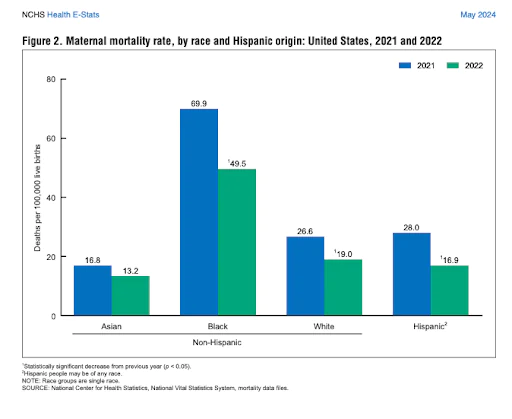
Axios reports on newly released CDC data sharing the mortality rate for Black mothers in the U.S. has not improved, with a 2023 Lancet article finding “even Black women in areas with more access to maternal health care are at a disproportionately higher risk of dying during or after childbirth than white women who live in underserved areas.”
How Health Plans Can Improve Rural Maternal Health
Across healthcare stakeholders, efforts to reduce disparities include expanding access to coverage and care, greater access to expanded service offerings, availability of providers that support maternal and infant health, diversifying the health care workforce, and enhanced data collection and reporting. Addressing rural maternal health and care is crucial for health equity initiatives as it presents unique and disproportionately higher challenges, and organizations are using innovative programs and partnerships to move forward. For example, perinatal quality collaboratives work towards improvements in obstetric outcomes and provide strategies to advance equity.
Click here to see visual representation of the social and economic inequities that drive health disparities.
Health plans can work towards improving maternal health by implementing value-based care models that incentivize high-quality, coordinated care throughout pregnancy and postpartum. Comprehensive maternal health services, including lactation support, doula care, and mental health support, can help close gaps in care and improve health outcomes.
Access to equitable care in underserved rural communities is not just a matter of improving individual outcomes – it’s a fundamental issue that demands our collective attention and collaborative action. We must work together to ensure that every mother, regardless of zip code, has the best chance of a healthy mom and baby journey.
Are you a health plan interested in learning how our services can enhance your maternal care program? You can learn more here.
SOURCES:
- Center for Healthcare Quality and Payment Reform. (2026, July). Rural hospitals at risk of closing. https://www.ruralhospitals.org
- Centers for Disease Control and Prevention. (2025, December 18). Data from the Pregnancy Mortality Surveillance System. U.S. Department of Health and Human Services. https://www.cdc.gov/maternal-mortality/php/pregnancy-mortality-surveillance-data/
- Centers for Disease Control and Prevention. (2026, April 27). Breastfeeding benefits both baby and mom. U.S. Department of Health and Human Services. https://www.cdc.gov/breastfeeding/features/breastfeeding-benefits.html
- Centers for Medicare & Medicaid Services. (2024). Transforming Maternal Health (TMaH) Model. U.S. Department of Health and Human Services. https://www.cms.gov/priorities/innovation/innovation-models/tmah
- Crear-Perry, J., Correa-de-Araujo, R., Lewis Johnson, T., McLemore, M. R., Neilson, E., & Wallace, M. (2021). Social and structural determinants of health inequities in maternal health. Journal of Women’s Health, 30(2), 230–235. https://doi.org/10.1089/jwh.2020.8882
- Crawford, A., Felida, N., Hu, X., & Dill, M. (2021, April). Differences in access to medical and maternal care among women ages 18–54 (AAMC Workforce Studies Data Snapshot). Association of American Medical Colleges. https://www.aamc.org/media/52146/download
- Gebreyes, K., Bhatt, J., Rabinowitz, D., Gerhardt, W., Williams, M. A., & Keita, M. (2024, September 25). The $2.8 trillion opportunity: How better health for all can drive U.S. economic growth. Deloitte Insights. https://www.deloitte.com/us/en/insights/industry/health-care/health-equity-economic-impact.html
- Gunja, M. Z., Gumas, E. D., Masitha, R., & Zephyrin, L. C. (2024, June 4). Insights into the U.S. maternal mortality crisis: An international comparison. The Commonwealth Fund. https://doi.org/10.26099/cthn-st75
- Gunja, M. Z., Tikkanen, R., Seervai, S., & Collins, S. R. (2018, December 19). What is the status of women’s health and health care in the U.S. compared to ten other countries? The Commonwealth Fund. https://doi.org/10.26099/wy8a-7w13
- Hill, L., Rao, A., Artiga, S., & Ranji, U. (2025, December 3). Racial disparities in maternal and infant health: Current status and key issues. KFF. https://www.kff.org/racial-equity-and-health-policy/racial-disparities-in-maternal-and-infant-health-current-status-and-key-issues/
- Hoyert, D. L. (2024, May 2). Maternal mortality rates in the United States, 2022. National Center for Health Statistics. https://stacks.cdc.gov/view/cdc/152992
- Mallenbaum, C. (2025, February 6). Maternal deaths drop—except for Black women. Axios. https://www.axios.com/2025/02/06/black-maternal-mortality-rate-cdc-chart
- March of Dimes. (2024, September 10). Maternity care desert report reveals millions unable to access care. https://www.marchofdimes.org/about/news/maternity-care-desert-report-reveals-millions-unable-to-access-care
- Meek, J. Y., Noble, L., & Section on Breastfeeding. (2022). Policy statement: Breastfeeding and the use of human milk. Pediatrics, 150(1), e2022057988. https://doi.org/10.1542/peds.2022-057988
- Office of the Surgeon General. (2020). The Surgeon General’s call to action to improve maternal health. U.S. Department of Health and Human Services. https://www.ncbi.nlm.nih.gov/books/NBK568218/
- Stoneburner, A., Lucas, R., Fontenot, J., Brigance, C., Jones, E., & DeMaria, A. L. (2024). Nowhere to go: Maternity care deserts across the US (Report No. 4). March of Dimes. https://www.marchofdimes.org/maternity-care-deserts-report
- Valerio, V. C., Downey, J., Sgaier, S. K., Callaghan, W. M., Hammer, B., & Smittenaar, P. (2023). Black-White disparities in maternal vulnerability and adverse pregnancy outcomes: An ecological population study in the United States, 2014–2018. The Lancet Regional Health – Americas, 20, 100456. https://www.thelancet.com/journals/lanam/article/PIIS2667-193X(23)00030-3/fulltext
- World Health Organization. (2018, February 22). Health inequities and their causes. https://www.who.int/news-room/facts-in-pictures/detail/health-inequities-and-their-causes
- World Health Organization. (n.d.). Breastfeeding. https://www.who.int/health-topics/breastfeeding